
Introduction
In the digital age, it is often said that there are only two types of companies: those that have been hacked, and those that don't yet know they have been hacked. Recognizing the inevitability of cybersecurity incidents, India’s Digital Personal Data Protection (DPDP) Act, 2023, places a profound emphasis on incident response and transparency.
While preventing breaches is the goal, how an organization responds when a breach occurs is what the law heavily penalizes. The DPDP Act introduces strict, non-negotiable requirements for reporting personal data breaches, marking a significant shift from previous, more ambiguous cybersecurity guidelines in India.
This guide unpacks the data breach notification requirements under the DPDP Act, helping organizations prepare their incident response plans before a crisis hits.
Defining a Personal Data Breach
Before you can report a breach, you must understand what the law considers a breach. Under the DPDP Act, a "personal data breach" is defined broadly as any unauthorized processing of personal data or accidental disclosure, acquisition, sharing, use, alteration, destruction, or loss of access to personal data, that compromises the confidentiality, integrity, or availability of personal data.
It is crucial to note that a breach is not just an external hacker stealing a database. It includes:
- Accidental Disclosure: An employee emailing a spreadsheet of customer data to the wrong recipient.
- Loss of Access: A ransomware attack that encrypts patient records, making them unavailable to doctors.
- Unauthorized Alteration: A malicious actor modifying financial records within an internal system.
The Dual-Notification Mandate
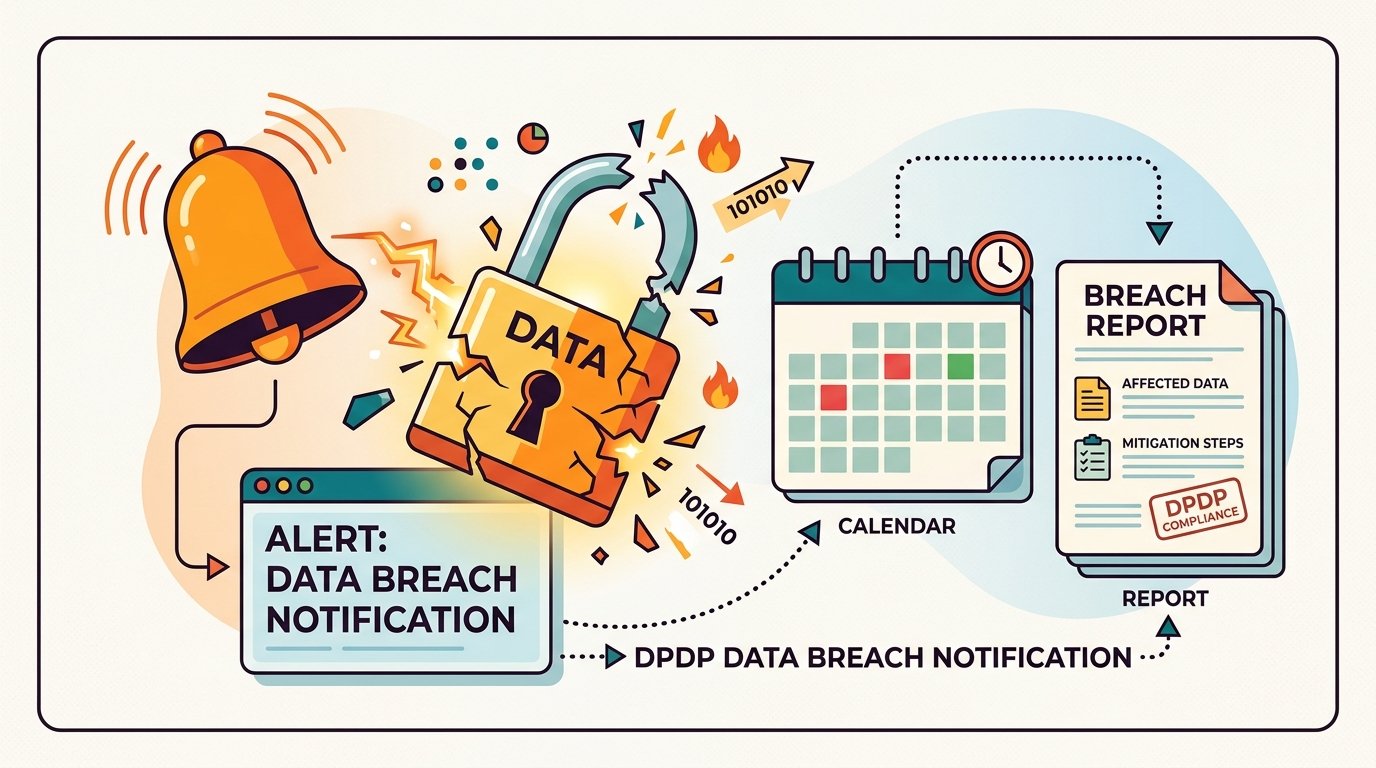
When a breach occurs, the DPDP Act mandates a dual-notification process. This is one of the most stringent aspects of the law.
1. Notifying the Data Protection Board of India (DPBI)
Every Data Fiduciary (the entity determining the purpose and means of processing data) must intimate the Data Protection Board of India in the event of a personal data breach. The DPBI is the regulatory body tasked with enforcing the Act and assessing penalties.
2. Notifying the Affected Data Principals
Simultaneously, the Data Fiduciary must also notify every single affected individual (Data Principal) whose data has been compromised. This is a significant departure from laws like the GDPR, which only require notifying individuals if the breach poses a "high risk" to their rights and freedoms. Under the DPDP Act, the requirement to notify the individual appears absolute, regardless of the perceived severity of the breach.
What Must the Notification Contain?
While the exact forms and templates will be prescribed in the finalized Rules, standard global practice and the overarching intent of the DPDP Act suggest that a breach notification must be clear, transparent, and actionable. It will likely need to include:
- Nature of the Breach: A description of what happened (e.g., unauthorized access, ransomware).
- Data Categories Affected: What specific personal data was compromised (e.g., names, financial details, health records).
- Potential Consequences: The likely impact on the individual (e.g., risk of identity theft or financial fraud).
- Mitigation Steps Taken: What the company has already done to contain the breach and secure the systems.
- Actions for the Individual: Recommendations for what the Data Principal should do to protect themselves (e.g., changing passwords, monitoring bank statements).
- Contact Point: Details of the authorized person or Data Protection Officer for further inquiries.
The Role of Data Processors
Many breaches occur not at the Data Fiduciary level, but at the Data Processor level (e.g., a cloud hosting provider or a third-party payroll service). The DPDP Act states that the Data Fiduciary remains ultimately responsible. Therefore, Data Fiduciaries must ensure their contracts with Data Processors include strict obligations for the processor to notify the fiduciary immediately upon discovering a breach, enabling the fiduciary to meet its legal reporting timelines to the DPBI and the public.
Penalties for Failure to Notify
The financial stakes for mishandling a breach are astronomical. The DPDP Act prescribes specific maximum penalties related to security incidents:
- Failure to take reasonable security safeguards to prevent a personal data breach: Up to ₹250 Crores.
- Failure to notify the Board and affected Data Principals of a personal data breach: Up to ₹200 Crores.
An organization could theoretically face cumulative fines if they both fail to secure the data and subsequently try to cover up or fail to report the resulting breach.
Preparing Your Incident Response Plan
Compliance cannot be achieved on the day a breach occurs. Organizations must act now:
- Draft an Incident Response Plan (IRP): Create a step-by-step playbook detailing who identifies a breach, who contains it, and who is responsible for drafting and issuing the notifications.
- Conduct Tabletop Exercises: Regularly simulate data breach scenarios with your executive, legal, IT, and PR teams to test the effectiveness of your IRP.
- Review Vendor Contracts: Ensure all third-party agreements mandate rapid notification of security incidents.
Transparency is no longer just good public relations; under the DPDP Act, it is a strict legal requirement. By preparing robust notification procedures, organizations can mitigate regulatory fines and maintain customer trust even in the face of a cyber crisis.